
The Martyrdom Gambit
Is Nicolás Maduro's sham trial in Manhattan part of something pre-negotiated with the Trump administration?

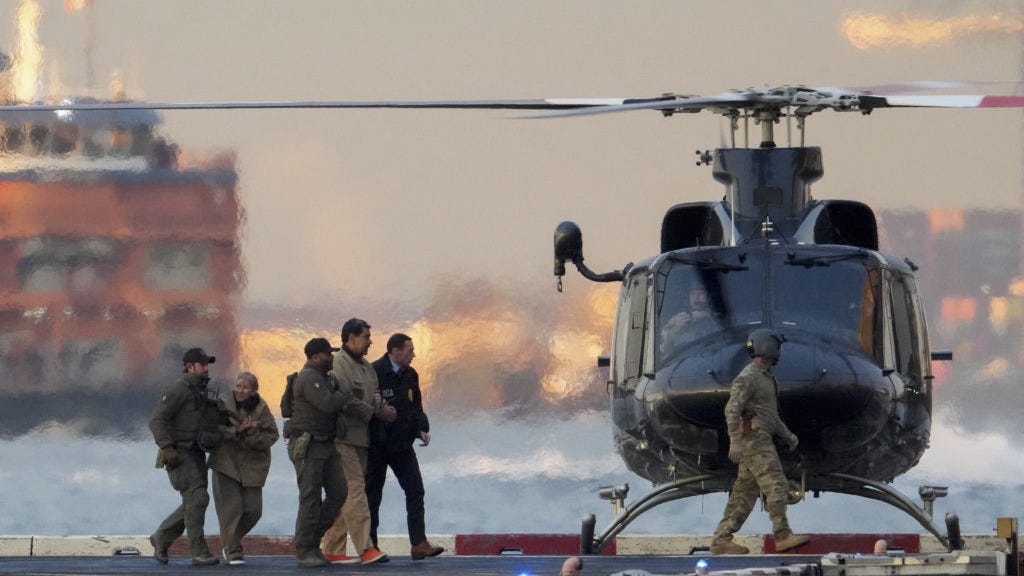
After the bombing of Caracus and violent kidnapping of Venezuelan President Nicolás Maduro and his wife by US forces, federal agents paraded them through the streets of New York City to make their first appearance in front of a 92-year-old federal judge, infamous 9/11 judicial cover-up artist and AmerIsraeli dual citizen Judge Alvin Hellerstein.
Maduro entered a ‘not guilty’ plea in court, telling the judge, “I’m innocent. I’m a decent man. I’m the President of Venezuela. I consider myself a prisoner of war. I was captured at my home in Caracas.”
Judge Hellerstein was assigned to oversee 9/11 related civil lawsuits, including one in which he urged the families of 96 victims to take settlement money instead of taking the case to a public trial. According to the New York Times, Judge Hellerstein encouraged the families of the victims, who questioned the failures in airline and airport security in their lawsuit, to receive settlement money instead of taking the case to trial, which he acknowledged resulted in a ‘loss of information’ to the public.
Going to trial would have brought a trove of internal documents and depositions to public light before a jury. One of the victims’ families stated that Hellerstein ‘gutted the case so that the truth about what led to the events of 9/11 would never be told at trial.’
Aside from this, Hellerstein has ruled against the government numerous times, including to allow release of Abu Ghraib torture photos and ruling against Trump’s use of the Alien Enemies Act to deport Venezuelans. Hellerstein’s mixed record makes it difficult to assess how he would rule in this case, though a devout Zionist is the last person on Earth we want presiding over a show trial on politically motivated charges.
For the US government, Hellerstein seems to be the perfect judge for this trial. He is a Clinton appointee and has ruled against Trump before. They will use this to claim impartiality, saying even a “liberal judge” couldn’t refute the government’s evidence against Maduro.
But, of course, this reeks of hypocrisy and double standard. If the United States can bomb Venezuela to kidnap Maduro, an elected president, and put him on trial in American courts, then why can’t we bomb Tel Aviv to capture Benjamin Netanyahu from Israel and bring him before international court? For that matter, why can’t we capture Donald Trump from the White House and bring him before a judge for all his endless crimes? We know why. I digress.
Was Maduro’s Kidnapping Part of a Pre-Arranged Deal?
With the PSUV government remaining largely intact and VP Delcy serving as interim head of state while repeatedly reaffirming her loyalty to President Maduro, an unexpected possibility emerges: this may have been a pre-arranged deal, likely a modified version of Maduro’s December proposal.
Maduro’s son, Nicolás Maduro Guerra, has declared his full support for acting president Delcy Rodriguez and Venezuela’s interim government. Given the circumstances, the Venezuelan people appear remarkably unified—a striking development that lends credence to the theory of careful orchestration rather than chaotic collapse.
According to reports, Maduro offered to step down under specific conditions—that VP Delcy replace him, US sanctions be lifted, and that he and members of his government receive amnesty. Trump’s immediate dismissal of ground invasion possibilities and his swift rejection of opposition leader Machado’s push for regime change suggest potential “negotiation space” between the two leaders.
The scenario fits Trump’s established pattern: prioritizing spectacle and the appearance of dominance over sustained military engagement. A staged “capture” would allow the US a calculated show of force while Venezuela strikes oil deals that help the US consolidate Western energy dominance. Meanwhile, the PSUV continues governing with Maduro’s chosen successor, and Maduro himself potentially serves a brief US prison term before receiving a pardon—emerging as a martyr figure for Chavismo.
The strategic logic is straightforward. Maduro’s leverage was limited to Venezuela’s natural resources and the threat of protracted conflict—a potential Latin American quagmire the Trump administration would be keen to avoid. For Maduro, the calculus may have been clear: either face sustained missile strikes that Venezuela’s air defenses couldn’t withstand, resulting in higher casualties and destabilization, or accept a dramatic but controlled transition that preserves the Bolivarian Revolution’s continuity.
The reported deaths of 32 Cuban soldiers could represent either a communication breakdown or an unauthorized escalation by US forces once on the ground. Either way, the casualty count remains significantly lower than what a protracted remote conflict would have produced.
This theory remains speculative, particularly given the unclear outcome of the ongoing sham trial. Yet Maduro’s core demand—that Delcy be allowed to govern—appears to have been met. Even US oil companies seem unenthusiastic about the potential supply surplus, preferring higher prices to increased production. Until more details emerge, the possibility that Maduro martyred himself as part of a long-game strategy cannot be dismissed.